To delete or not to delete Inactive subscribers? That is the question!

To Delete or Not to Delete? That Is the Question

Over the years, various email marketing practices have become rooted as best practice – including the recommendation to delete subscribers who show no engagement (no opens, no clicks) in your ESP. 

The irony, however, is that on many email platforms, subscribers who appear active aren’t necessarily active in any meaningful sense, and those who appear inactive may well re-engage over time. 

Moreover, email also plays a critically important subliminal role in brand awareness. So what is actually the right approach?

To Delete or Not to Delete? That Is the Question.

One of the most persistent questions in email marketing is: What should you do with subscribers who haven’t opened an email in weeks or months?

The prevailing industry view is simple – remove subscribers who show no activity (no opens, no clicks) in the ESP. Thereby, “cleaning” the data that’s “getting in the way,” improving your metrics, and preventing the deliverability issues that can arise from mailing to disengaged contacts.

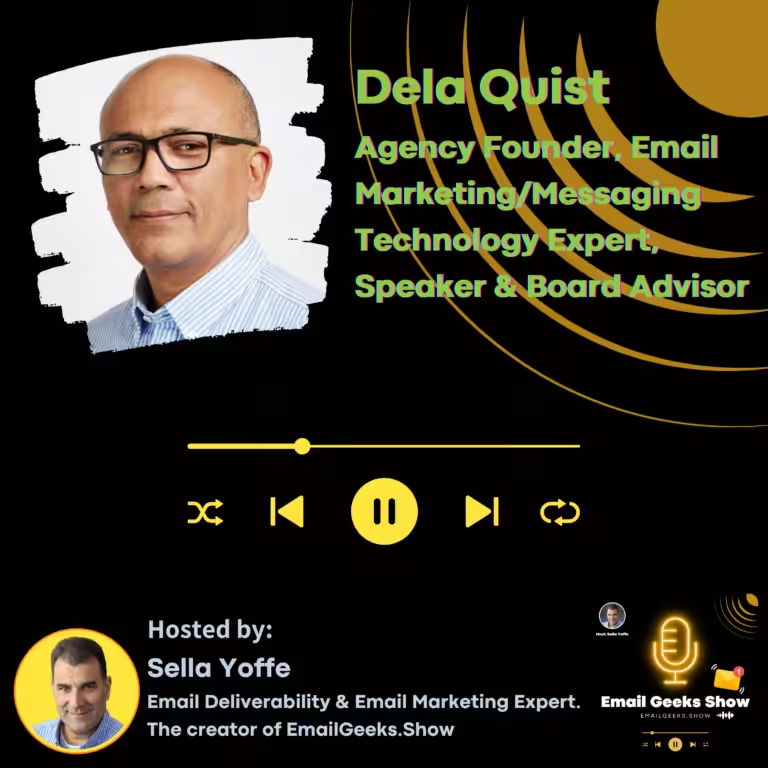
But is that the right strategy? I learned from Dela Quist – one of the sharpest minds in the industry – that this is a far more complex reality that emerges, and that there is no single answer that applies to every program or every scenario.

Challenging the Status Quo and the Notion of “Best Practice”

Dela Quist is an entrepreneur, speaker, and senior email marketing consultant who built a global reputation not only by founding Alchemy Worx – the world’s largest email marketing agency – but through his critical thinking and his ability to challenge assumptions that most practitioners simply accept as given.

Is What’s Considered Best Practice Actually Right for You?

The industry’s usual approach is to suppress subscribers who haven’t opened an email within a certain timeframe – such as a few months, six months, a year, or more. This is a strategy that many ESPs actively promote to their clients, and it’s easy to see why: it benefits their own commercial goals. The reasoning is straightforward: open rates improve, reports look better, and the perceived risk of deliverability problems lessens.

Dela’s argument is that point-in-time measurement of opens and a narrow focus on immediately observable engagement within the ESP are fundamentally short-sighted. There are subscribers who haven’t opened an email in a very long time but who then, one day, return and make a purchase – sometimes after three full years of apparent silence. Delete them, and you permanently lose the opportunity to communicate with them.

The Experiment That Changed Everything

Dela’s defining case study comes from an engagement he conducted with a British sports media channel. The client refused to remove inactive subscribers, and Dela decided to prove them wrong – at his own expense.

He divided the list into three groups: actives, inactives (a full year with no opens), and an empty group into which reactivated subscribers would flow.

Over four years, he tracked the data. The result was striking: even after three years of zero opens, a small but meaningful percentage of inactive subscribers opened an email and responded to an offer.

It is worth noting that this was an era when open-rate data was considerably more accurate – a point we’ll address shortly.

In ROI terms, those subscribers proved highly profitable. The cost of sending to them was negligible, and the value generated was substantially higher than the cost of acquiring new customers through paid channels like Google, Meta, or TikTok.

Exposure Is Everything – Email as a Billboard

Perhaps because of his background in advertising, Dela draws a natural parallel between email marketing and billboard or television advertising. In those channels, no one expects the audience to take immediate action. The objective is repeated exposure – impressions – that reinforce the brand in memory.

The power of email, even when it goes unopened in the inbox, lies in the psychology of the human mind, which responds to repeated exposure even subliminally. This is precisely why billboards, radio spots, television ads, and even logos continue to work without requiring a click.

By the same logic, even when a subscriber never opens your email, the simple appearance of the sender name (the “friendly from”), the subject line, and the pre-header text (That one is a bit disrupted these days because of AI summaries), and and a BIMI logo (if your brand have it), creates a brand presence that registers at some level.

Audience Management – There Are No “Good” or “Bad” Subscribers

Dela’s approach to the distinction between active and inactive subscribers finds its clearest expression in the concept of Audience Management. His position is that there are no “good” subscribers and “bad” subscribers – only people at different stages of the customer lifecycle. A subscriber who hasn’t engaged with an email in a year might re-engage tomorrow. A subscriber who is highly active today may go completely dark next month. This is precisely why maintaining a continuous dialogue matters. Stopping the conversation with your subscribers is equivalent to giving up on them. “You cannot re-engage someone you’ve stopped talking to”, he said.


The ROI of Inactive Subscribers

Dela recommends tracking an overlooked metric: Open-to-Unsubscribe Ratio. As long as this ratio remains low, continuing to email inactive subscribers can be profitable. When the ratio climbs toward 1:1 – meaning people are opening only to unsubscribe – that is a meaningful signal that the messaging is failing.

He notes that a reactivated subscriber can be worth anywhere from 2.5x to 7x as much as a regular subscriber. He also raises the opportunity cost dimension: many senders spend heavily on paid traffic to reach people who are already sitting on their list – people they stopped mailing simply because they appeared “inactive” in their ESP.

The Irony: With many ESPs, You Cannot Reliably Use Engagement Data

Relying on opens and clicks as indicators of subscriber activity has become deeply problematic in recent years, driven primarily by the sharp rise in Non-Human Interactions (NHI).

The most significant contributor is Apple Mail Privacy Protection (MPP), which pre-fetches all images – including the tracking image pixel – automatically in the background, even if the user never actually opens the message. The practical consequence is that every recipient on an Apple device appears to have opened every email, artificially inflating open rates, sometimes by tens of percentage points. Opens no longer reflect genuine human behavior; they predominantly reflect automated prefetching.

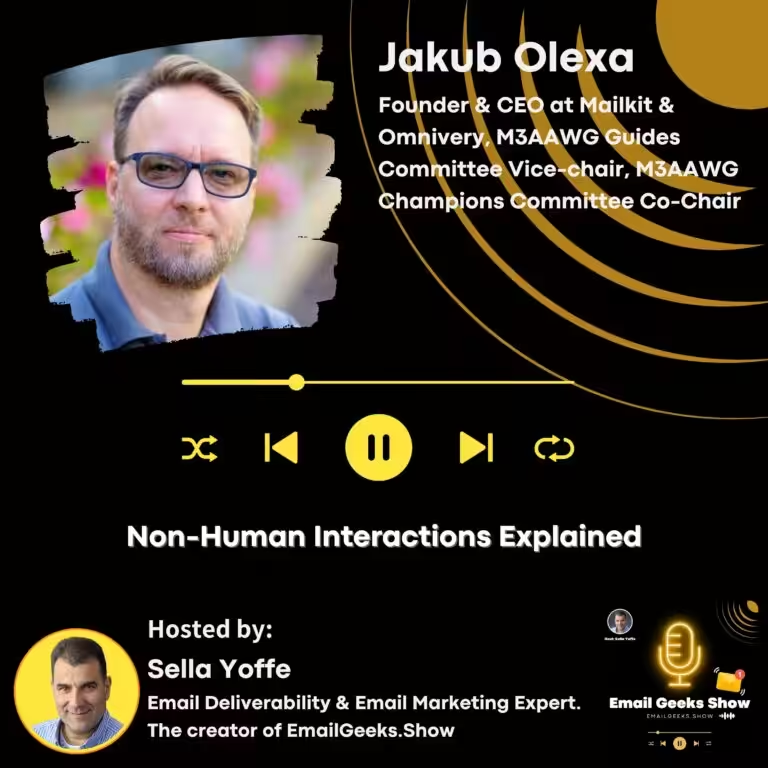
I discussed this at length with Jakub Olexa, CEO and founder of Mailkit and Omnivery, and one of the world’s leading experts on Non-Human Interactions in email.

Click data has also become less reliable, particularly in B2B enterprise environments, but increasingly in B2C as well. Security scanners, firewalls, and anti-virus and anti-phishing solutions automatically scan every link in an email for malicious content. In many cases, they click every link – sometimes from multiple IP addresses across different countries – and all of this happens without the recipient ever interacting with the message.

When automations are triggered based on these machine-generated clicks, follow-up emails are sent to contacts who never actually engaged, wasting resources and potentially damaging the sender’s reputation.

Beyond statistical distortion, the operational consequences are real. Audience segmentation strategies, list hygiene policies, and sunset policies that rely on “opens” or “clicks” as their signal are liable to retain large numbers of genuinely inactive contacts – and may even retain spam traps.

The result is inflated lists that continue to receive mail, elevated deliverability risk, and growing difficulty meeting the engagement expectations that major mailbox providers use to evaluate sender reputation.

The correct approach is to rely on more reliable signals: purchase data, website visits attributable to an email campaign, or other strong behavioral indicators of genuine user activity – and to leverage your platform’s NHI filtering capabilities wherever they are available.

So, what should you actually do with Inactive subscribers?

In today’s crowded inbox environment, where competition is fierce and attention spans are shrinking, the sending frequency for engaged subscribers should be around 1 email per week (minimum), while unengaged contacts should be on a lower cadence, often mixed with inactive subscribers.

Sending less frequently than that erodes brand recall and reduces the probability of re-engaging dormant contacts.

That said, higher-frequency sending must be executed intelligently: vary the format, diversify content, test new ideas, and adapt the messaging specifically for the inactive segment. The inactive audience can, in fact, warrant more strategic attention than the active one precisely because the goal is to bring it back to life.

There is no formula that applies universally across all email programs. What is generally appropriate is to calibrate the sending frequency by segment: contacts who appear more engaged with the ESP (depending on whether the ESP supports detecting non-human interactions) receive emails more frequently, while those who appear inactive receive them at a reduced cadence, without suppressing them entirely.

Email Deliverability & Email Marketing expert | Website |  + posts

Email Deliverability & Email Marketing Expert 💌
Podcast host & Blogger @ CRM.BUZZ , EmailGeeks.Show, and emailmarketing.buzz

Scroll to Top

This website uses cookies to enhance your browsing experience and ensure the site functions properly. By continuing to use this site, you acknowledge and accept our use of cookies.

Accept All